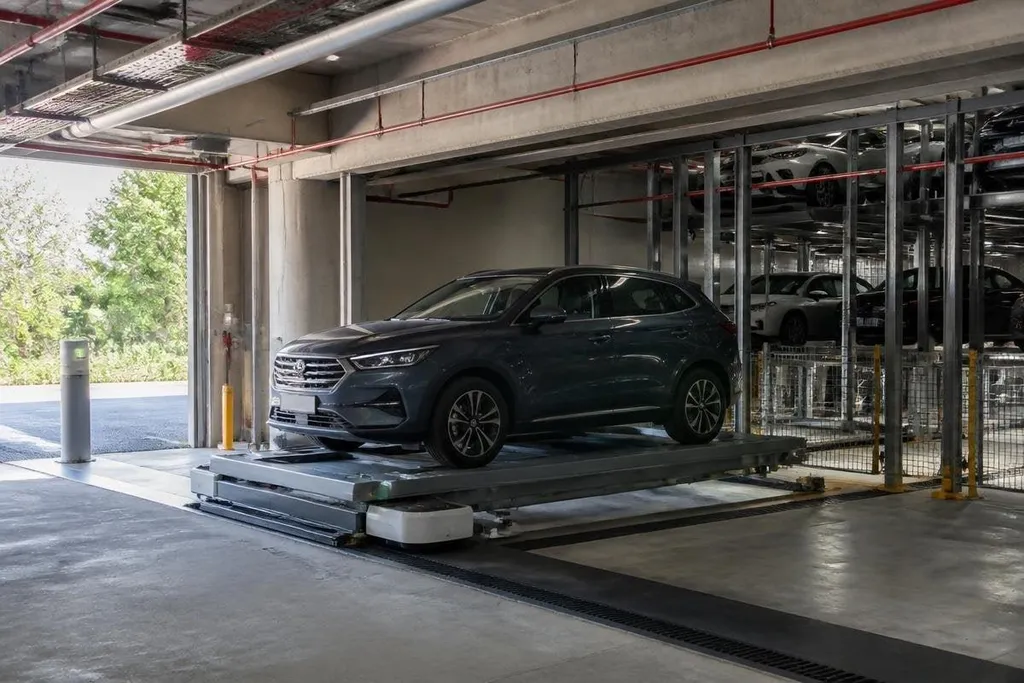
A parking robot can move a car from an entry point to a storage space without the driver searching for a bay. That idea is gaining attention because land, building space, and driver time are costly in dense areas.
Quick read:
- Robots move cars on platforms, lifts, or guided carts.
- Drivers leave the car in a handover area and collect it later.
- The system works best where space is tight and parking demand is steady.
How parking robots work
A driver enters a marked handover area and follows the system’s instructions. Sensors check the vehicle’s position, while software records its size and assigns a storage space.
The car then moves on a platform, or a small mobile robot carries it to another position. Lifts can move cars between floors, and conveyors or sliding platforms can shift rows sideways. Each method removes the need for wide driving lanes inside the parking area.
That space saving explains much of the interest. A regular garage needs room for doors, turning, ramps, and people walking between cars. An automated garage can place vehicles closer together because the robot handles the movement after the driver leaves.
The process also separates people from moving vehicles. Drivers wait in a handover zone instead of walking through a dark garage or searching beside reversing cars. The safety gain depends on good barriers, sensors, emergency controls, and clear operating rules.
Why owners are looking at them
Land is often the largest constraint in a parking project. A robot-based garage can store more cars in the same building footprint, although the result depends on the layout, equipment, and local building rules.
Construction costs also shape the decision. A system may reduce the space needed for ramps and internal lanes, but it adds lifts, platforms, sensors, control software, and service work. The financial case only works when the space saved is worth more than the equipment and upkeep.
Speed at the entrance matters too. A driver can leave the car in one place while the system handles storage. At busy times, that may reduce the slow search for an empty bay, though retrieval can still take time when many people request cars together.
Parking robots also fit sites with fixed demand. Apartment buildings, hospitals, airports, and city garages can plan around known arrival patterns. A small site with irregular use may find the equipment harder to justify.
Building rules can decide whether a parking robot fits the site. The garage still needs room for ramps, fire access, vehicle height, and a safe handoff at the entrance. Robot24 can connect those design details to the robot's claimed job before the next section looks at where these systems can fail.
Where the limits appear
The robot needs a controlled space. A loose object, a badly placed vehicle, a blocked sensor, or a software fault can stop the process and require staff intervention.
Vehicle size matters. The system may reject cars above a set height, length, width, or weight. Roof boxes, trailers, bikes, and open windows can also create problems, depending on the design.
Retrieval is another practical limit. A driver may expect a car immediately, but the system has to locate it, move other vehicles if needed, and bring it to the handover point. The waiting time depends on the number of lifts, storage layout, and demand at that moment.
Maintenance cannot be treated as an afterthought. Motors, rollers, lifts, cameras, barriers, and software all need checks. If the garage stops during a busy period, staff need a clear way to release vehicles safely and explain the delay.
I’d support parking robots where land is tight and the operator can fund regular service; I’d skip them for a low-use site with a simple surface lot.
A practical buying check
Before choosing a system, check these points with the supplier and the site team:
- Vehicle limits: list the largest and heaviest vehicles the garage must accept.
- Peak retrieval: ask how the system handles a rush of drivers leaving together.
- Failure procedure: confirm how staff release a car after a sensor or power fault.
- Service plan: check response times, spare parts, software support, and inspection duties.
- User access: test the handover area for people with mobility needs and large luggage.
- Fire rules: confirm how the design meets local fire access and emergency requirements.
The strongest use case is a site where every square metre matters and vehicle demand is predictable. The open question is whether the operator can keep the system working for years, not whether a robot can move one car in a controlled demonstration.